Rock your ROI: How to prove the value of your internal social media efforts
Whether internal or external, showing a campaign worked requires knowing what to measure, who to show it to and how to make it land.


Many executives treat social media as an afterthought, and doubly so for intranets and internal social media platforms. It’s a recurring battle that sends the comms pros who carefully curate those platforms into a quiet rage spiral because you know full well that no one asks the value of the sales team’s work.
After hours spent on a campaign that made employees and followers alike do exactly what you planned, how do you explain to the bigwigs why it worked and why it matters?
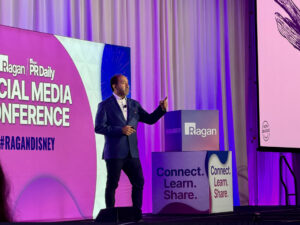
Because social can prove its value when you treat your content like a strategic tool and your metrics like a flashlight. At PR Daily’s 2025 Social Media Conference, three panelists — Jayli Barkley of the Riverside County District Attorney’s Office, Alejandro Fuenmayor of Tombras, and Heather Brinckerhoff of Great American Media — showed how to turn anecdotes into proof points and how to get stakeholders to actually listen.
Here’s how to make your social media story both visible and valuable.
Lead with the human
Barkley doesn’t run a typical brand account. As principal district attorney information specialist for Riverside County, California, she’s part of a public-facing law enforcement agency with a political leader, a high-stakes mandate, and a community that often only interacts with them through the justice system. So building trust is critical to maintaining the organization’s authority and preventing a constant social media firestorm.
It’s not complicated: Show the people behind the job. “We recently posted two of our staff who are in leadership out in our East County. They are Little League coaches,” she said. “We didn’t post them with suits, we didn’t post them with any identifying information about them being from our office, but just that these are people who are a part of your community.” As to its performance, “that got a huge engagement on social media because we want the community to know that these are folks that are also a part of the community.”
That kind of humanized content not only builds morale inside the office but strengthens public confidence in a system many feel distant from.
High-impact posts are often simply those seen by exactly the right people, even if they don’t hit viral status. “They’re still very potent, they’re still deliberate, and they’re still intentional, and they’re landing with the people who you would want them to — that is, a prominent community member, someone who has a lot of notoriety in the community.”
Get on course
Supporting Barkley’s point, Fuenmayor hammered home the refrain that ROI starts at the business objective, not the platform dashboard. “The exercise I recommend you guys do is actually put down on a piece of paper your communications plan or architecture,” he said. “What am I trying to do, how am I trying to accomplish it and how am I going to measure that it actually works?”
Fuenmayor knows how tempting it is to measure what’s measurable instead of what matters. “If we talk about engagement, the only thing you’re trying to do is get a good engagement rate. You might get a post that only reaches five people, but then three of them engage. That looks great on paper,” he said. But then “you’re not then doing your actual organizational goal.”
For one retail client, Tombras used social to drive awareness, yes, but more importantly, a measurable lift in four- and five-star reviews on local listings. Then they correlated that to a 2% increase in sales at the same locations. “We went from talking about a social metric… to actually talking about the return on investment.” That’s the connective tissue most execs care about.
Think beyond borders
Barkley’s office tackled a cold case involving a body found in Riverside County, later linked to convicted serial killer Keith Hunter Jesperson, known colloquially as the “Happy Face Killer.”
Their policework reached out to five different states to reach regional media in places Jesperson had ties, Barkley said Not typically the lane of a local DA’s office. But what they needed was leads.
“We set out with just wanting to secure at least 50 tangible goals or leads to try to get to the bottom of this case,” Barkley said. “We ended up with over a hundred in just a few weeks’ time.” The team reached beyond their immediate jurisdiction, amplified the story through borrowed audiences and used social as the springboard.
This is what happens when you treat collaboration as a serious distribution strategy. “We just reached out on a whim and tapped into their audiences to see if we could collaborate with them to get the story out,” she said. “And that was very, very successful for us.”
If that’s not ROI, what is?
Tell your story
For Heather Brinckerhoff, vice president of social media and digital content at Great American Media, the magic lies in reporting — specifically, how you package performance for people who don’t speak fluent analytics.
She keeps it simple. “Here’s the three top metrics we’re looking at: We look at impressions, engagements and follower growth,” she said. Then she spotlights top posts and the bottom of the barrel. “So that senior leadership starts to understand that the things that are really looking like an ad or salesy are not working.”
And it’s working: “One conversation that I had actually with my CEO… he said to me, wow, after you going through these social recaps with me, it’s really making me understand that we were doing social totally wrong before. We were coming at it in a way that was more of a benefit to us than to the audience.”
Social often opens doors rather than closing deals.
Brinckerhoff put it this way: “Organic social is not generally a quick sales driver, right? … You are part of the sales funnel in the ecosystem, but just in a different way than a channel like paid social or email.”
Basically, stop forcing social into a role it wasn’t built for. Instead, ask what kind of lift it can provide elsewhere in the ecosystem. For Brinckerhoff’s former team at QVC, it was audience connection that eventually turned into sales.
Ultimately, ROI is easier to prove when you stop chasing it and start planning for it, working backward into a campaign from community needs and desired business outcomes. If you’re humanizing your brand, if your content is translating to real-world action, if your leadership is starting to say, “Oh, now I get it”, you’ve hit the mark.