Crisis Communications Certificate Course
Readiness, Response and Reputation Control in a Volatile Stakeholder Ecosystem
July 16, 23, & 30 2026 | 1-3 p.m. ET
Two consecutive modules and office hours
Is your company ready for its next crisis?
Crisis readiness is now a business imperative for communicators and leaders across any company. Issues accelerate across channels, stakeholders react in parallel, and alignment across leadership, employees, media and regulators must happen in real time.
This three-week certificate course equips communicators and leaders with the ability to build a full crisis readiness system, grounded in a threat matrix, cross-functional alignment, and a structured playbook that guides decision-making under pressure. You will learn how to determine when to respond, how to mobilize the right stakeholders, and how to deliver coordinated messaging across every audience.
You will leave with a working crisis framework, clear response protocols, and the confidence to lead through high-pressure moments while protecting reputation and business continuity.
Whether you face operational disruption, misinformation, workforce unrest, regulatory scrutiny or cyber risk, this course prepares you to align leadership, guide the narrative and maintain stakeholder trust.
You’ll Get Access To:
- Expert Insight: Learn from university faculty, in-house leaders and agency crisis specialists who bring real-world experience managing high-stakes events.
- Crisis Comms Playbook: Develop a modern crisis communications playbook built for speed and scale.
- Immediate Application: Walk away prepared for real-world scenarios communicators face every day, and the crisis that could emerge tomorrow.
- Crisis Leadership: Navigate successfully through the fog of crisis. Lead across internal stakeholders while mitigating reputational harm through authentic external engagement.
- Live Coaching: Gain instruction you can apply immediately in high-pressure situations.
CURRICULUM
Skills You’ll Learn:
- Build adaptable crisis communications frameworks that connect internal communications, media response and public channels into one coordinated effort.
- Shape messaging as employee inquiries, media requests and social commentary accelerate.
- Prepare leaders as spokespeople, both for internal and external engagement.
- Use AI and listening tools to detect early signals, from emerging rumors to sudden spikes in employee or customer concerns.
- Respond with precision during moments such as product failures, data breaches, safety incidents and viral backlash.
- Guide interpretation across stakeholders, media and internal audiences as narratives evolve.
- Measure sentiment, trust and recovery across employees, customers and the public.
A workforce reduction sets off speculation among your employees at ground zero. A regulatory issue surfaces, and employees hear about it from the news first. A hurricane is forecast to hit your largest facility, significantly disrupting operations. Moments like these test your crisis readiness. This session focuses on crisis preparedness and building the playbook now so that you can quickly respond with clarity to all those impacted, internally and externally.
You will start with building a threat matrix that defines potential risks, assigns severity levels and determines response pathways. From there, you will build the playbook that aligns stakeholders, messaging and execution.
You’ll explore how to structure decision-making, define roles across departments and prepare messaging frameworks that scale.
You’ll learn:
- Threat Matrix Development: Identify risks, assign severity levels and map response strategies across scenarios.
- Internal Alignment: Build cross-functional buy-in across leadership, legal, HR, compliance, operations and executive teams.
- Playbook Design: Create workflows, approval processes, escalation paths and notification protocols.
- Message Architecture: Develop scenario-based messaging that adapts across internal and external audiences.
- Spokesperson Preparation: Train executives and internal leaders to communicate effectively in both formal and informal moments.
- Listening Infrastructure: Establish tools and processes to detect early signals and inform decision-making.
Case Study Spotlight: Examine how preparation shaped successful crisis outcomes and where breakdowns occurred.
Practical Application Exercise:
Bring a high-risk scenario from your organization. Begin building your threat matrix and response framework with peer feedback.

Once a crisis emerges, information (and misinformation) moves rapidly across channels, and the pressure on you, your team and company rises just as fast. Internal chatter, social commentary and media inquiries begin to escalate, each influencing the situation, whether factual or not. Early in crises, stakeholders are already interpreting before you draft your first response. This session prepares you for that phase.
You will learn how to track emerging signals, interpret sentiment across audiences, and shape responses and announcements that protect reputation and maintain stability during any maelstrom.
You'll learn:
- Playbook Activation: Execute response protocols based on severity and scenario.
- Spokesperson Mobilization: Identify and deploy the right voices across internal and external audiences.
- Channel Strategy: Coordinate messaging across employee communications, PR, social platforms and executive visibility.
- Response Decision-Making: Determine when to issue statements, engage interviews or lead with owned content to guide the narrative as information evolves and pressure intensifies.
- Executive Briefing: Deliver clear, actionable updates that support leadership decision-making.
- Impact Measurement: Track sentiment, trust and message penetration to refine the response in real time.
Case Study Spotlight: Analyze how organizations executed crisis responses, including what worked, what failed and what leaders would change.
Practical Application Exercise:
Refine your crisis scenario and apply response strategies based on your Week 1 framework.


Bring your work into the room. This session focuses on applying what you have built to real-world situations. We will review assignments and explore how crisis frameworks perform under pressure - strengthening your messaging, execution and response through direct feedback.
During office hours, you’ll receive:
- Live Feedback and Coaching: Refine your crisis frameworks, messaging and response strategies.
- Case Study Breakdowns: Examine how organizations managed internal and external narratives during high-pressure moments.
- Peer Insight: Learn how others are preparing for and responding to similar challenges.
- Open Q&A: Pressure-test ideas and troubleshoot real scenarios.
CLASSROOM MATERIALS
(Exclusive for Attendees)
- Crisis Planning Checklist
- Crisis Comms Log Template
- Crisis Comms Holding Statement
- IABC’s 5 Stages of Crisis Recovery and Reputation Repair
Skills You’ll Develop:
- Crisis Framework Design: Build systems grounded in threat matrices, decision tiers and cross-functional alignment.
- Platform-Responsive Messaging: Deliver consistent messaging across internal channels, media and digital platforms.
- AI-Assisted Response: Use tools such as ChatGPT, Claude and Copilot for drafting, analysis and decision support.
- Signal Detection and Monitoring: Identify early indicators of emerging risk.
- Sentiment Analysis: Interpret audience response to guide communication strategy.
- Executive and Employee Communication: Prepare leaders and teams for high-visibility communication.
- Narrative Control: Shape interpretation during fast-moving events.
- Reputation Management: Reinforce trust during and after crisis events.
- Strategic Response Messaging: Deliver clear, disciplined communication under pressure.
Top reasons to attend this virtual certificate course
- Strategies for anticipating crises before they happen and developing a plan for unavoidable situations.
- How to create frameworks and craft messaging to help your organization get through emergencies and PR crises.
- Tips for coaching and working with leadership to ensure that your entire organization can move ahead.
- Advice on what tools and technology to use to develop effective crisis communications swiftly and efficiently.
- Ways to identify what your audience needs to hear from your brand in the most challenging times.
- How to keep an ear to the ground to understand your audience and avert potential crises.
- Identify the right metrics to help you understand what needs to be done before, during and after a crisis to keep people safe, informed and confident in your organization.
Secure your seat today for this exclusive crisis communications course offered by Ragan and PR Daily, and level up your copy, tracking, tools and tactics.
| Early Bird | Regular Rate | |
|---|---|---|
| Certificate Course Registration | $1,499 | $1,699 |
| Ragan Insider | $1,399 | $1,599 |
| Nonprofit/Gov/Edu | $1,349 | $1,549 |
Group pricing for 3 or more is available when going through the registration process!
If you can’t attend one or more of the modules live, you will receive the on-demand versions to complete the course.
WHO ATTENDS
Communications and public relations professionals from these organizations have earned certificates:










WONDERING IF YOU SHOULD ATTEND?
Here’s what past attendees say about the Crisis Communications Certificate Course!

The Ragan Communications Crisis Communications Certificate Course provided our team with invaluable insights and strategies to navigate challenging situations with confidence and clarity. The curriculum was comprehensive, practical, and equipped us with the tools needed to communicate effectively under pressure. This course is a must for any organization committed to protecting its reputation and building trust with stakeholders during times of crisis.
I thoroughly enjoyed this three-day course. It went so quickly! Jam-packed with insightful nuggets and useful resources. Great instructors, content packaged in a useful way. Will be back for more courses!
This has truly been one of the best virtual courses I've ever taken. Thanks to my IC peers for the lively chat discussions and LinkedIn connections, to our instructors each session for such insightful and engaging content, and to the Ragan team!
Ragan Communications knows what keeps communicators up at night. Its workshops, topics and speakers get right to the heart of what we need to elevate our work.
Ragan is the absolute best. I have been a loyal follower of their education and resources for years. They have helped improve communication in my company and increase engagement and satisfaction.
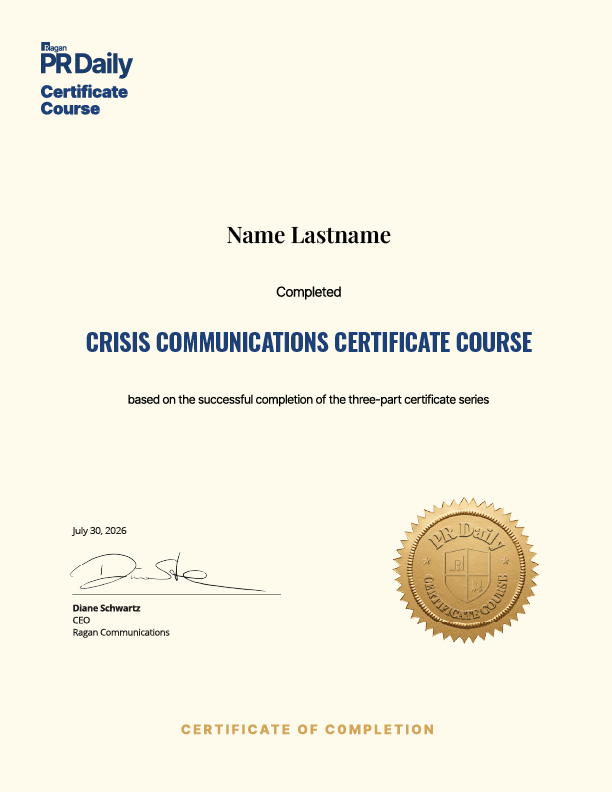
Get Recognized!
This three-week Crisis Communications Certificate Course equips you to lead with clarity when the pressure is highest and the stakes are real. Learn how to prepare for disruption, respond in real time, and protect your organization’s reputation in an increasingly volatile stakeholder environment. Complete the program and earn your Certificate of Completion!