3 priorities to lock in before the next AI vendor incident
Your AI vendor’s performance problems will hit before you have language to describe it. Here’s a readiness checklist.



Stephanie Nivinskus is principal at Ragan’s Center for AI Strategy.
Every company using AI internally needs a plan for the day its vendor becomes the story.
Last week, it was Anthropic. Users spent weeks on Reddit complaining about Claude’s slipping performance. Anthropic denied it, as reported by Fortune, until they didn’t.
The company then published an engineering post-mortem detailing three changes that had degraded Claude’s performance over the previous month, giving comms leaders a glimpse of a significant risk: trusting AI vendors over your users.
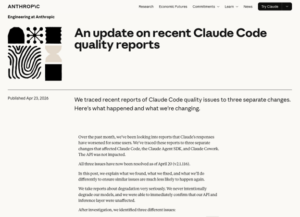
Source: Anthropic engineering blog, April 23, 2026
Communications now operates inside an environment where the quality of AI-generated work can change without warning. Proactive companies can use this phased roadmap to mitigate unwanted surprises.
Phase 1: Prepare before the vendor becomes the problem.
- Map every internal workflow that depends on an external AI vendor. Capture the vendor, the workflow, the audience and the business owner.
- Identify every single-vendor dependency. Flag any workflow where one provider supports executive briefings, employee communications or crisis response.
- Name a vendor monitoring owner. One person in your company should spend 10 minutes per day tracking vendor release notes, status pages and engineering blogs for your top two AI vendors.
- Draft three holding statements: a vendor outage, a quality regression and a pricing or access change. Get signoff from your legal department and then store them for use as needed.
- Define the escalation path. Document who approves internal messaging, who can pause AI-assisted workflows and who briefs the executive team.
- Brief your principals. The CEO, COO and head of HR should know that AI vendor incidents are now part of comms readiness.
Phase 2: Treat reports from your employees as warning signs and respond promptly.
- Activate the protocol as soon as possible. Do not wait for vendor confirmation.
- Clearly explain what your team is experiencing, what your team is doing as a workaround and when the next update will come.
- Give managers talking points so they avoid making something up on the spot.
- Send your holding statement before forwarding the vendor’s communication. Vendors write their updates to protect themselves. Employees need internal clarity instead.
- Pause any AI-assisted workflow with executive or reputational exposure until you launch the workaround.
- Log every decision in a single document. The post-incident review team will need it.
Phase 3: Recover after the vendor moves on.
- Run a 30-minute internal review within five business days. What surfaced internally before the vendor confirmed? What slowed the response? What language landed and what did not?
- Update your holding statements based on your review.
- Re-audit single-vendor dependencies. If the incident exposed a critical workflow with no fallback, consider shifting your budget to allow for a better solution.
- Share documented incident reports with IT and legal. The governance argument for comms ownership of AI risk strengthens with each one.
- Add the vendor’s response pattern to your monitoring profile. A vendor that takes weeks to confirm degradation tells you something useful, without telling you anything at all.
Why preparation pays
The teams that work through this roadmap before the next incident will be positioned to work around it without skipping a beat. While the readiness preparation is not glamorous, the alternative costs more.
Learn more from the Center for AI Strategy.