From Barbie buzz to Barney at Heidi Klum’s Party: Mattel’s comms director on making moments matter
Casey McDonald of Mattel shares how to create buzz and build something worth paying attention to.

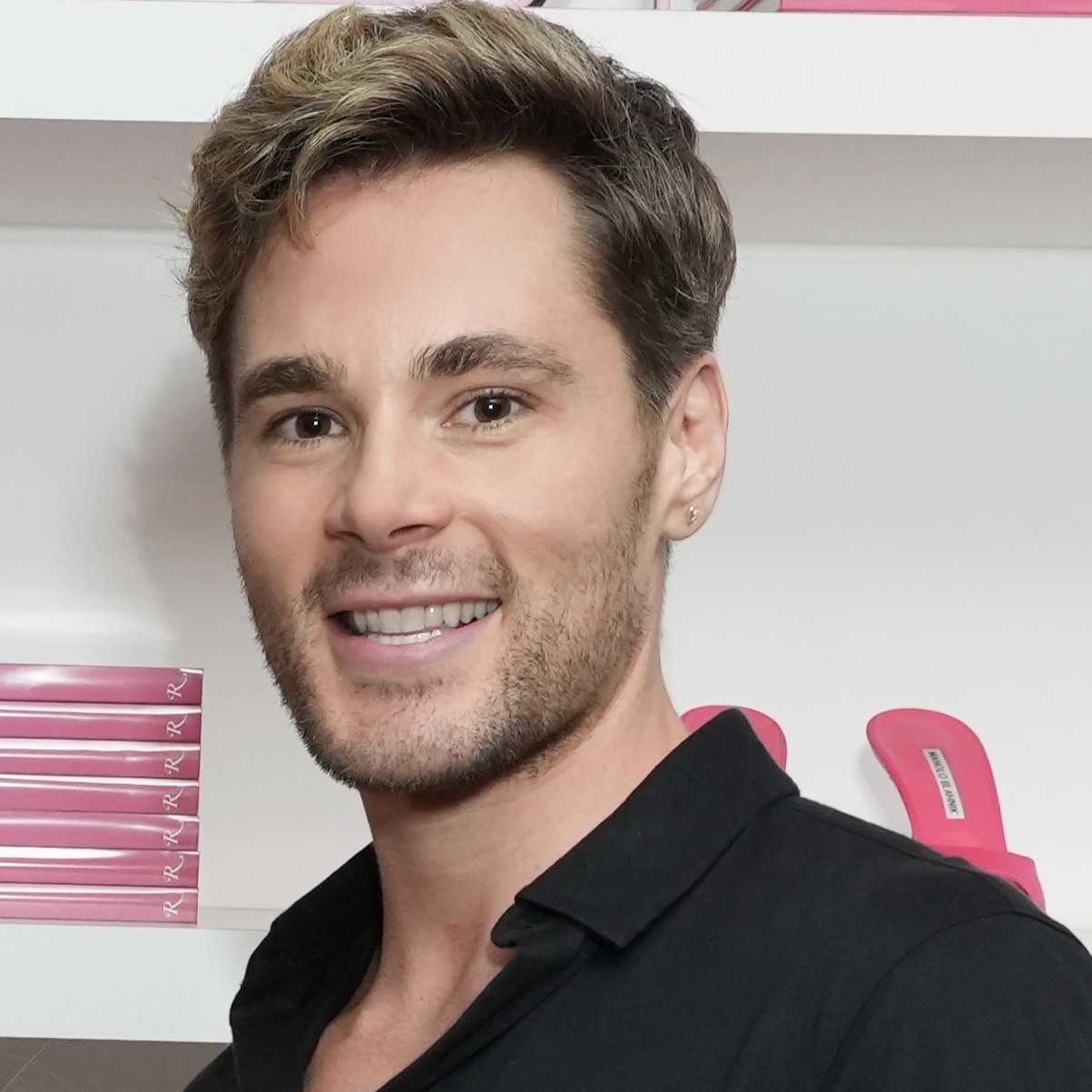
Casey McDonald helps shape the stories behind some of the world’s most iconic brands. As Mattel’s director of global communications, he leads communications across entertainment, gaming and corporate storytelling. McDonald played a key role in the record-breaking campaign for “Barbie” and now oversees communications for Mattel’s film and television slate, digital gaming business, executive visibility and major entertainment partnerships. Before joining Mattel, he spent a decade at agencies representing brands including Vuori, ASOS, Macy’s, Tinder, To Boot New York and OLIPOP. He most recently served as vice president at The Lead PR.
A graduate of Westminster College, McDonald was a standout member of the men’s swimming team and now swaps laps for long runs and Peloton rides. Originally from Pittsburgh, he lives in Los Angeles with his husband and their toy fox terrier, who remains convinced that every neighborhood walk is a press tour.
His career offers a candid look at how great communicators find the story, earn attention and keep even global campaigns feeling human.
You have worked on both the agency and in-house sides of communications. What did each teach you that the other could not?
I am incredibly grateful to have cut my teeth in the agency world. Managing a roster of clients across industries taught me to be scrappy, curious, and relentlessly solutions-oriented. Agency life is fast, and there’s always another strategy due, another client call starting, another opportunity to chase. It forces you to become comfortable with ambiguity and figure things out quickly.
Because agency life revolves so much around “the pitch,” it also gave me a deep respect for journalists. You quickly learn that reporters don’t owe you coverage; they’re looking for stories that are timely, relevant, and genuinely interesting. That perspective has stayed with me throughout my career and has hopefully made me a better partner to the press.
In-house has been a completely different education. You’re no longer parachuting into someone else’s business; you become part of it. You learn that communications isn’t just about telling stories, it’s about helping shape them alongside colleagues across creative, marketing, product, and countless other teams. You also realize that every announcement is connected to a much larger business strategy. Some of my favorite days at Mattel aren’t necessarily when we’re launching something huge—though those are fun too—they’re when I’m sitting around a table with my team asking, “Is there a bigger story here?”
The agency experience taught me how to create buzz. In-house taught me how to build something worth paying attention to.
What surprised you most when you first stepped into a global communications role?
The scale. Mattel was much larger than I had imagined. It took time to understand how the business operated and how different teams fit together.
What surprised me even more, though, was the sheer amount of brand equity behind Mattel’s brands. At an agency, you’re often working tirelessly to convince people why they should care about a story. At Mattel, the brands have already earned decades of trust and cultural relevance. That doesn’t mean the work gets easier; it actually raises the bar. Every announcement has to deserve the attention it receives.
One of the biggest shifts for me has been spending as much time identifying stories as telling them. My team isn’t just thinking about messaging; we’re constantly looking across the business asking, “What’s genuinely interesting here? What advances our narrative, and how does that advance the company’s strategy? What will matter six months from now, not just tomorrow?” Having iconic brands certainly opens doors. The responsibility is making sure what walks through those doors means something.
How do you make a global story feel consistent without making it feel one-size-fits-all?
Every communications effort should begin with three simple questions:
Who is this for?
What are we trying to say?
Why does it matter?
If everyone is aligned with the answers, you’ve already solved most of the problem. From there, I think consistency and flexibility can coexist. The core message, purpose, and strategic objective should remain consistent around the world. But the way that story comes to life should absolutely flex based on audience, market, and culture.
I’ve learned that consistency isn’t necessarily about everyone using the exact same words. It’s about everyone telling the same brand narrative in a way that feels authentic. Some of the most impactful ideas we’ve implemented globally originated from local teams who understood their markets better than anyone else. Great global communications is a team sport.
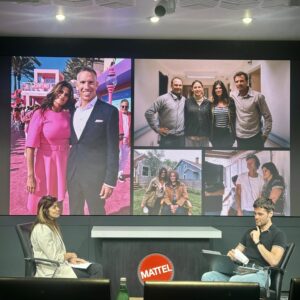
MIPCOM 2025 keynote prep with President of Mattel Studios & Chief Content Officer Robbie Brenner
Is there a campaign or project that changed how you think about the power of communications?
So many, but the Barbie movie campaign in 2023 has to take the cake. I’ve never been part of something with so many synergies or that level of widespread excitement. Between the film itself and our partnership with Warner Bros., more than 165 consumer products collaborations, and what felt like an endless stream of launches across fashion, beauty, gaming, hospitality and beyond, the world quite literally turned pink for an entire summer. It was a masterclass in integrated communications, and I still think about that campaign whenever we’re building something new. I think I always will.
Barbie catapulted Mattel into the cultural zeitgeist like never before. Between the pages of The New Yorker, The New York Times, The Wall Street Journal and countless other dream publications, I’m fairly certain the campaign broke every earned media dashboard I’ve ever used.
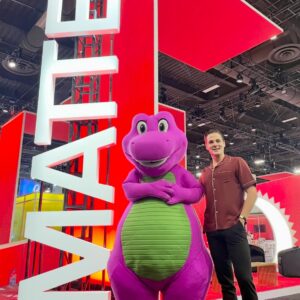
Barney at Las Vegas Licensing Expo 2024
Which Mattel toy or brand would your younger self be most excited to learn you now represent?
Barney. No question. I was absolutely obsessed as a kid. I had the VHS tapes, the stuffed animals and, perhaps most importantly, a full-body Barney Halloween costume that I enthusiastically repurposed as everyday attire for about six months. My parents were very patient.
Fast forward a few decades, and I somehow found myself helping lead communications for Mattel’s Barney relaunch across television, consumer products, publishing and more. I even got to escort Barney himself to Heidi Klum’s Halloween party, which is not a sentence I ever expected to say professionally.
Barney has had a fascinating place in the culture over the years, but what he has always represented—kindness, empathy and helping young audiences understand and express their emotions—still feels incredibly relevant today. I think the world could always use a little more of that.
What is something your colleagues would be surprised to learn about you?
Early in my career, I was dead set on specializing. I thought I had to become “the tech PR guy” or “the fashion PR guy” or “the entertainment PR guy.” Ironically, the longer I’ve been in communications, the more I’ve realized my specialty is communications itself. I’ve been extremely fortunate to have opportunities across corporate, brand, technology, fashion, consumer products, entertainment, gaming, and more. I’ve found that great storytelling looks remarkably similar regardless of the subject matter. Every role has made me better at the next one because the fundamentals never really change: understand your audience, find the story, and tell it authentically.
I never know what my day is going to look like, and I actually love that. One morning I might be discussing AI, and by the afternoon I’m figuring out how to get an eight-foot purple dinosaur into a celebrity Halloween party. That’s comms, and honestly, I wouldn’t have it any other way.

Masters of the Universe film set
Isis Simpson-Mersha is a conference producer/ reporter for Ragan. Follow her on LinkedIn.