Communicators know business acumen matters. Most don’t feel ready.
There’s a sizable gap between what communicators think they should know and what they feel comfortable with.


Communicators are in nearly unanimous agreement that understanding key business functions and terminology is a critical part of their toolkit.
But most admit they aren’t comfortable with those skills.
According to new research conducted jointly by Ragan Communications and the Institute for Public Relations, 94% of communicators say that it’s somewhat or very important to have an understanding of business acumen – that is, a firm knowledge of business terminology and principles.
But when you scratch the surface and ask communicators how confident they are in their own understanding of those topics, we see a gap.
What communicators should know
First, the survey asked communicators to identify topics it’s important for communicators to be knowledgeable about. Here are the knowledge areas they deemed most important:
- Digital communication tools and technologies: 98%
- Artificial intelligence (AI): 96%
- Organizational behavior, culture, and structure: 96%
- Business ethics: 95%
- Data analytics and measurement in communication: 95%
- Marketing: 95%
- Key Performance Indicators (KPIs): Setting, measuring, and aligning KPIs with business objectives: 92%
- Social responsibility: 91%
- Business operations: 90%
- Stakeholder management: 88%
- Leadership & Governance: Board of Directors, C-suite roles, & corporate governance: 82%
- Legal, public policy, and regulatory affairs: 80%
- Human resources: 72%
- Financial Literacy: Interpreting financial statements: 68%
- Lean and agile concepts and tools: 59%
- Mergers and acquisitions: 59%
Unsurprisingly, the most-required skills focused specifically on the comms function: digital tools, AI, ethics, analytics and measurement, and setting KPIs.
We also see that communicators are expected to have a firm understanding of the areas of the business they interact with most: marketing, business operations, legal and human resources.
Finally, we reach a set of skills that most respondents agreed communicators should have that focus on true business skills, like interpreting financial statements or the M&A process. These topics, while important to a communicator’s practice, probably weren’t taught during their college education.
And indeed, communicators overwhelmingly report that they did not learn these skills in class. Rather, 80% are figuring out business acumen on the job or through independent study, with just 32% acquiring business skills through undergraduate study programs.
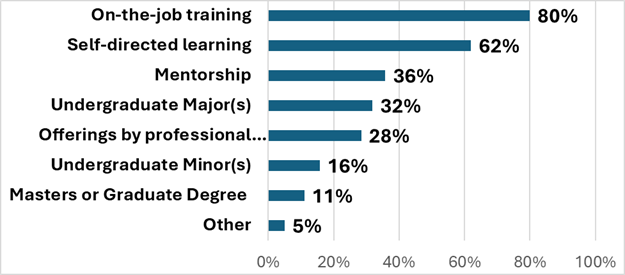
This lack of formalized training may explain why communicators reported that they lacked a firm understanding of concepts they knew were important. This is illustrated when we drill deeper into specific business topics and compare how important communicators think they are versus their own understanding.
On a list of topics ranging from reading a balance sheet to stock market essentials, there was an average gap of 29.5 points between what communicators thought was important and their own understanding of the topic.
For instance, 70% of communicators said it was important that they understand quarterly financial statements and earnings reports, but only 36% rated themselves as very or moderately knowledgeable on the subject. That 34-point gap was the highest of any item surveyed.
What it means
Communicators recognize the need to be well-informed about business topics, but most lack formal education in these areas and are forced to cobble together an understanding through peer learning and their own investigations.
To gain that vaunted seat at the table, communicators have to demonstrate they know the stakes. That means coming prepared with knowledge of the business that they can put into action.
The teams that thrive in 2026 are the ones that put an emphasis on not just leveling up their communications game, but on improving their overall business knowledge. Organized, systematic training can help take “I should know this” to “I’m implementing this today.”
Allison Carter is editorial director of PR Daily and Ragan.com. Follow her on LinkedIn.