What CCOs are saying about the future of communications
Real insights from the real people shaping what comes next.


CCOs are charting a new path forward.
They’re figuring out where AI fits into comms, how to prove business value and how to reach audiences that are more fragmented than ever.
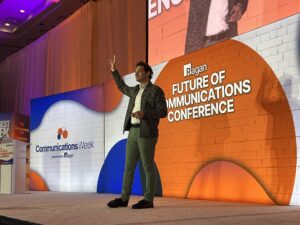
More than a dozen C-suiters will take the stage at Ragan’s Future of Communications Conference, held in Austin Nov. 13-16. They’ll offer a view from the top on where the profession stands now — and where it’s headed next.
Here’s what they’re thinking about.
Influence is harder to define
Legacy media doesn’t hold the same power it once did. Media relations has changed, probably for good. But communicators aren’t standing still.
The question is no longer just where your story appears. It’s where it travels next.
Jenna McMullin, chief communications officer at Lockheed Martin, will tackle how influence now moves through creators, trade publications, newsletters, niche communities and GEO alongside traditional news organizations.
For Ashok Sinha, chief communications officer at Dow Jones, the issue is just as broad. Podcasts, newsletters, trade outlets and AI-driven search are all shaping reputation, often at the same time.
AI is becoming a reputation and governance issue
The next phase of AI in communications is about much more than drafting copy.
Gabrielle Gambrell, chief communications officer at Hachette Book Group, and Stephen Hahn-Griffiths, chief reputation & strategy officer at The RepTrak Company, will push into what happens when AI becomes more visible: synthetic personalities, AI-generated spokespeople, autonomous systems and virtual executives.
That opens up harder questions. Who is accountable when an automated system speaks publicly? What needs to be disclosed? What happens to trust when audiences can’t tell whether they’re interacting with a person?
Eric Villines, chief communications officer at Anker, takes an internal comms view of the situation. Employees are adopting AI faster than many companies can create policies around it, which means comms teams may be pulled into decisions about acceptable use, escalation and human oversight.
Communicators are moving beyond explaining AI rules and now becoming forces in their creation.
The CCO is moving deeper into business strategy
Relatively new to the C-suite, the CCO role is still evolving.
Michelle Russo, chief communications officer at State Farm, is one clear example. She became the company’s first CCO, helping define the role and its place within the business.
Anthony Farina, chief communications and brand officer at FUJIFILM Americas, takes that evolution in another direction: business fluency. Senior communicators are increasingly expected to understand operations, risk, workforce sentiment and business priorities well enough to advise executives.
Tomorrow’s communications leaders will be judged on whether they can help leaders understand what matters, what could go wrong and how stakeholders are likely to respond.
Trust is harder to maintain
Restructurings. Layoffs. Return-to-office mandates. Constant transformation.
Employees have been through a lot.
Kristie Vainikos Stegen, chief brand and communications officer at Cotality, puts the spotlight on what that sustained disruption does to employee trust. When change never really stops, people can start tuning out even strong communications. That means change comms must become a continuous discipline.
Generational expectations add another wrinkle.
Olivia Frary, CMO at NOVA, brings Gen Z into the conversation. In the age of generative AI, younger employees may be especially skeptical of messaging that feels too polished, too generic or too obviously machine-made. So how can we balance the speed of machines and the empathy of humans?
Political risk is becoming reputational risk
Public affairs and corporate communications are getting harder to separate.
Mara Hedgecoth, CCO/CMO at APCO Worldwide, and Lee B. Gordon, CCO at Brunswick Corporation, will connect political and regulatory shifts to something every communicator understands: stakeholder trust.
Those changes can influence employee expectations, public positioning and decisions about when companies should speak.
And those questions don’t disappear when an election ends.
Political developments can turn into workforce issues, customer issues and reputation issues almost overnight.
For communicators, that means one question is coming into focus: When should the company speak, when should it stay quiet and what does each choice signal?
This year’s conference will take place less than two weeks after the midterm election, adding a special urgency to this question amid possible change in Washington.
Communications is moving closer to the center of the business
Put all of this together and the direction is hard to miss.
Senior communicators are thinking beyond media relations, messaging and content production. They’re thinking about AI governance, employee trust, political risk, executive influence and business strategy.
The job is getting bigger.
And it’s already taking shape.
Allison Carter is editorial director of PR Daily and Ragan.com. Follow her on LinkedIn.