What communicators say about their professional development opportunities
Most have it — but aren’t satisfied.


From the greenest intern to the most experienced CCO, continuing to learn and grow in your profession is vital. Most organizations recognize this and offer professional development of one type or another, according to Ragan’s 2025 Communications Industry Salary & Workplace Culture Survey Report.
Only 10% of respondents reported that their workplace did not offer professional development, while 6% were unsure what kind of development was offered. The other 84% indicated a wide variety of types of training to further their careers:
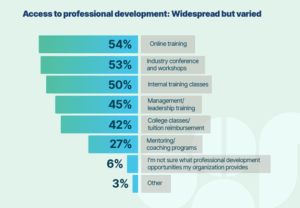
The offerings run the gamut, from personalized management to tuition reimbursement, all the way to online training, industry workshops and internal training courses. The breadth of offerings is admirable and shows that organizations understand how important professional development is to employee success and happiness.
The data bears that out: Of the workers who indicated they have no plans to leave their employer in the next year, 60% said they were satisfied or very satisfied with their professional development options. Conversely, 70% of workers who reported being dissatisfied or very dissatisfied with their professional development options were either planning to or considering leaving.
In other words, if you want to keep workers, ensure they have room to grow in your organization. Not only can training and development help workers build their skills, but it also helps them feel like their organization is investing in them. It might also help them find paths for career growth in the organization without feeling like they need to look for greener pastures.
But the bad news is that, despite widespread professional development options, most people aren’t satisfied with what’s on offer. Forty percent of respondents were satisfied or very satisfied, but 34% were only neutral, while 23% were dissatisfied.
Combined, this finds that the offerings may not be relevant, useful or in-depth enough to address the needs of workers. Workers also must be given time and freedom to use these tools without being burdened by their other work.
Open-ended responses give us an idea of what workers truly value from professional development:
- Personalized trainings that meet their unique needs rather than one-size fits all trainings.
- Cross-training and leadership: Workers don’t just want to level-up their skills in their area of expertise. They want the ability to network and learn from people from across the organization as well as executive leadership.
- An understanding of what skills will get them promoted. While many people learn for the love of it, there’s a financial and career advancement angle that must be addressed.
The importance of performance reviews
Performance reviews are a tool that can help managers and workers come together, sit down and focus on their strengths, room for improvement and path forward. Eighty percent of all respondents said they had an annual review in the last year, showing widespread adoption. But only 8% of respondents said the review was “very useful,” while 33% felt it either wasn’t useful or was actively detrimental. The remainder fell directly in the middle, with 42% finding them somewhat useful.
The bulk of respondents showing a vote of no confidence means it’s time for managers to reevaluate the annual review. Is it acting as a true chance to touch base with the employee and help them see their future with the company? Or is it just another box for everyone to check?
The full Salary & Workplace Culture Survey is available exclusively to members of Ragan’s Communications Leadership Council. But you can access the executive summary here at no cost.
Allison Carter is editorial director of PR Daily and Ragan.com. Follow her on LinkedIn.