How comms training must evolve for what AI can’t do
Allison Worldwide co-founder and former CEO Jonathan Heit on how training around soft skills and strategic thinking provides comms with a competitive edge.

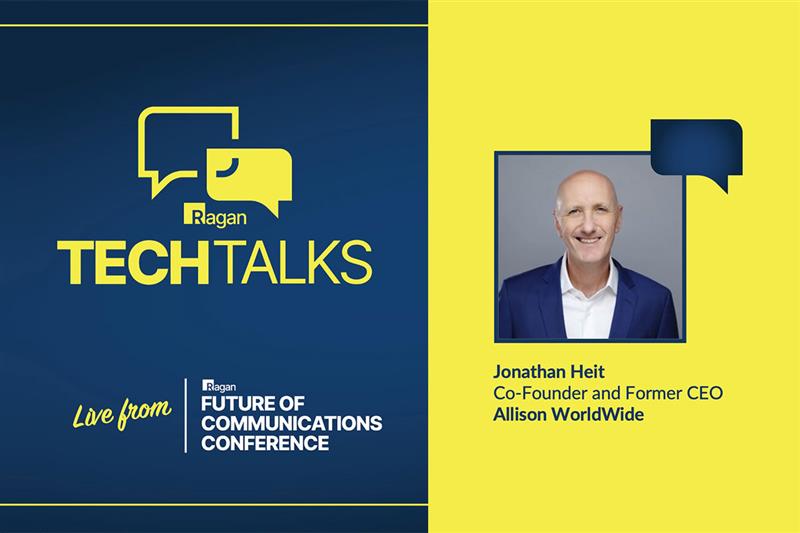


We begin the new year with a conscious choice to not humbled by the headwinds of 2025, but inspired by the tailwinds of human-grounded innovation and change that lie ahead. Rapid advances in AI continue to spur shifting expectations for comms pros at every stage of their career. At the center of this transformation are big, existential questions about how the communications function is currently valued by senior leaders and will continue to be valued.
The results of the 2025 Ragan and HarrisX CEO Perceptions Survey center around where this value creation lies, and some are jaw-dropping. But they are not cause for concern, according to former Allison WorldWide CEO and Co-Founder Jonathan Heit, whose agency is a sister brand to HarrisX under the Stagwell umbrella.
To the contrary, Heit looks at the survey results with a pragmatic optimism for comms’ ability to navigate uncertainty and measure reputation. During Ragan’s 2025 Future of Communications Conference, Height explained how these areas of focus bridge the gap between technology and human intuition, and how training in strategic thinking and soft skills that can get us there.
Strategic thinking and creative problem-solving remain human-led
Despite the encroachment of new technology, Heit argues that vital aspects of communications remain firmly human.
“There are some real core competencies of communications professionals that simply are not, and I don’t think ever will be, taken over by AI,” he said. “We can get information spat at us, but can you contextualize it—whether that’s from the earliest stages of the prompt, after the first draft is created, or when you’re reviewing final content? That’s something only humans can do.”
Heit also places an outsized emphasis on how empathy, ethics, and relationship-building ladder up to strategy, noting that strategic thinking and creative problem-solving top executives’ priorities.
“CEOs hold [those skills] at the absolute highest, far higher than they do data fluency or AI capabilities,” he said.
Measuring reputation in the age of analytics
Quantifying reputation remains an elusive but critical challenge. “Reputation, by some measures, is 25% of market value of a company,” explained Heit. “That’s why the CEO is so laser focused on it.”
While communicators have long been dogged by the “I don’t do math” stereotype when it comes to measurement, Heit pointed to new tools that bring unprecedented capabilities.
“What we’ve really invested heavily in is the predictive data and analytics piece,” he said, explaining how AI-assisted predictive analytics allow teams not just to gauge sentiment, but to anticipate stakeholder behavior: “If you can get out in front of that as a CEO, you are absolutely earning your keep. That is what keeps CEOs awake at night.”
One innovation is the use of “emotional intensity” as a metric to predict how stakeholders may act. “So by being able to measure emotional intensity of specific data, we could then see how your stakeholders are going to either make a purchase decision, if it’s your employees, how they are going to be engaged within your organization, or if it’s your shareholders, how are they going to move the needle,” continued Heit. Both large and small language models offer new ways to model outcomes, he explained, with “finite data sets” powering more targeted, agent-driven analysis.
Elevating early-career communicators
Heit sees a new meritocracy emerging with the rapid introduction of these new automations, especially for early-career practitioners who embrace data-driven approaches.
“You see a lot of young professionals really rising up through the ranks more quickly,” he said. “Those who take an interest in this data-driven approach, looking at it through that lens and combining earned media, which is another muscle… will start to rise up.”
This is where the ability to connect the dots between data and real-world impact remain human-led, and where communicators can demonstrate the most value. Heit said it will require more than relying on relationships or tenure, but understanding how it all works together.
One example of this is the emerging complexity of influencer relations, which is not a blend of paid and earned media.
“When you can say, by working with these three micro influencers, you’re going to do better and spend less than by working with this one mega celebrity, that’s got a lot of value,” Heit said.
Upskilling on the hard and soft skills
While AI continues to shift the landscape, Heit ultimately believes that learning and development will need to focus on skills that endure. “Recognize where your power is,” he said. “Whether that’s critical thinking or strategic advisory soft skills, they are going to be the most valuable in the future,” he said. “At the same time, keep updated on the hard skills.”
Heit cautioned that because the half-life of most tech skills is about two and a half years, at a pace that’s only accelerating, now is the time to lean in.
“Look at that as opportunity, because you can get in now and catch up so much more quickly than you could with a more entrenched in legacy technology,” he said. “You’ve got to have a growth mindset and [be] open to learning new technologies.”
He then closed with a challenge: “Test and learn. You know, you learn more from your failures than you do from your successes. Go ahead and use that custom AI tool today, you’ll see why the human element is still so important.”
Join Ragan Training for on-demand soft skills lessons in emotional intelligence, lessons in reputation management with and without AI, and much more. Learn more here.