How comms leaders are tying KPIs to business results
Engagement, reputation and revenue top the list.



Mike Prokopeak is director of Communications Leadership Council learning, community and content
Ask a communicator how they define the value they bring to their business and you’ll often hear answers like building trust, creating alignment, protecting brand and creating strategic clarity.
All are worthwhile goals. And all are at least one step removed from the sort of financial and business results that corporate leaders measure and report daily.
Key performance indicators (KPIs) close that gap. A well-defined comms KPI tied to business objectives makes clear communications’ contribution to enterprise value. A dozen senior communicators shared the KPIs they’re using during a focus group hosted by Ragan’s Communications Leadership Council at the recent Internal Communications Conference.
The knowing-doing gap
Most communicators agree that understanding how their organization makes its money is essential.
According to research conducted by Ragan and the Institute of Public Relations, 94% of communicators say that business acumen is important. Despite that, only 16% said they know how to set, measure and align KPIs with business outcomes.
Ragan’s 2026 Communications Benchmark Report confirms the uneven implementation of KPIs. More than half of comms teams report no alignment between their comms KPIs and business goals or align inconsistently. A quarter have defined their alignment, and just 23% have put those KPIs into practice and regularly report on them.
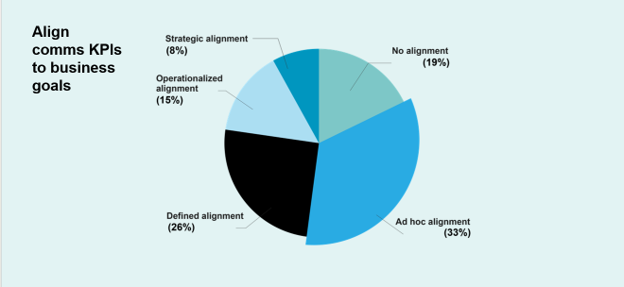
Source: 2026 Communications Benchmark Report, Ragan Communications Leadership Council.
Drawing a line between communications results and financial or business outcomes can sometimes be a leap of faith for skeptical business leaders and hesitant communications teams.
“Being able to measure how what we do actually drives those numbers is the really difficult part because there are so many variables that feed into that number,” said one participant from a large healthcare provider.
Anchoring the work in the priorities of the business is a way to positively shape how leadership perceives the function’s value.
What aligned KPIs look like in practice
The link is clear, if not always defined: Higher employee engagement boosts retention and decreases the cost of losing key employees. An effective crisis response preserves brand equity.
Employee engagement and corporate reputation top the list of KPIs that communicators tie to business goals, followed by stakeholder engagement, revenue growth and change adoption.
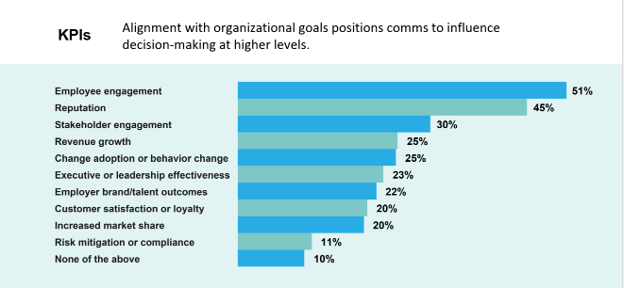
Source: 2026 Communications Benchmark Report, Ragan Communications Leadership Council.
In the focus group, communicators provided further examples. One leader from a software company ties their communications to annual recurring revenue, or ARR, the company’s core metric. Communications keeps sales staff informed about product trainings and commercial and marketplace changes, such as news that an existing customer won a new project that could create increased demand.
Sales team engagement in training, correlated to customer data, would be a potential KPI.
“From a comms perspective, whatever we’re communicating out to our sales colleagues has to go back to: How is it helping them increase adoption and consumption of the software?” she said.
Another communications leader, primarily focused on internal communications, said her team sits in the HR function, so their KPIs are closely aligned with HR priorities such as employee engagement, culture survey scores and external recognition as a top workplace.
A healthcare company ties their communications to key measures such as patients’ length of stay in the hospital and the readmission rate. Nurses are the biggest drivers of these outcomes, but they are difficult to reach. Activity metrics, such as distributing 3,000 flyers to nurses, don’t demonstrate impact. That’s a problem their team is still working to solve.
Trust, alignment and clarity still matter. But for communicators who want a seat at the table, the work starts with a different question: Not “What value do we bring?” but “Which number does our CEO watch, and how do we help move it?” Answer that, and comms’ value becomes much more clear.