How Microsoft’s ‘ambient listening’ and daily polls power connection
Live on the ground at Ragan’s Internal Communications Conference.

Robust data is one of an internal communicator’s most effective resources. With the right strategies, comms pros can turn that raw data into a major asset for their messaging plans.
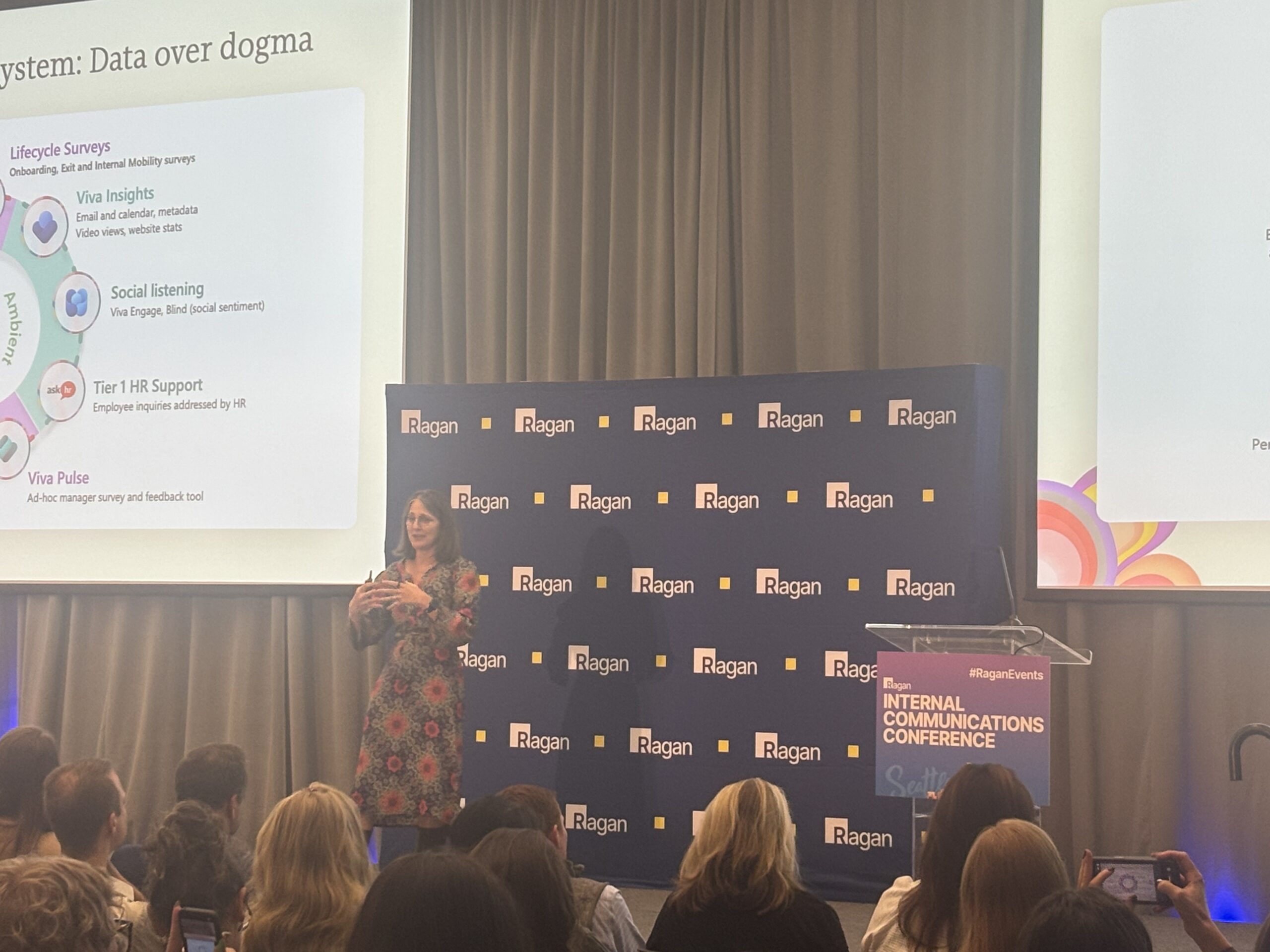
As the opening keynote speaker at Ragan’s Internal Communications Conference in Redmond, Washington, Dawn Klinghoffer, vice president of HR business insights at Microsoft, shared how her team zeroes in on the valuable employee data that informs how comms pros draw up messaging strategies. That includes both traditional active listening and what her team calls “ambient listening.”
“You might have heard of passive listening — we like to call it ambient listening,” she said. “At the end of the day, it’s all about having a dialogue with employees, whether it’s through active listening like pushing a survey or through ambient listening, which is the two-way dialogue all around us.”
She added that her team takes a holistic view of all the tools employees use to stay in touch with one another.
“It’s the digital exhaust,” she said. “It’s how people communicate, how they use Teams, chat, email and calendar. Understanding those behaviors is a really important aspect of the work that we do.”
Klinghoffer also drew a connection between the need for communicators to turn raw data learnings into concrete actions.
“When data people and comms people come together, that’s when you turn insights into action,” she said. “I can’t control the actions — I need partners. Because if employees don’t see action, they won’t be incentivized to provide feedback. It’s a cycle.”
Listening at scale
Adaptability is a skill comms pros need in order to best learn from what the data is telling them. Klinghoffer said that her team adjusted its strategy after it realized its process wasn’t getting the desired results.
“A few years ago, we had one employee census survey called MS Poll,” Klinghoffer said. “Once a year, we’d send it out and analyze it for months. By the time we acted, the data was stale. We needed more continuous listening. That’s when we created our Daily Signals survey, sent to 2,500 employees every business day. It gives us immense insight into what’s top of mind.”
She added that much of the power of the Daily Signals survey lies within its ability to elicit wide-ranging responses from Microsoft’s employees.
“The Daily Signals survey asks one simple but powerful open-ended question — ‘What’s top of mind for you right now?’” Klinghoffer said. “It can be internal or external. That single question has given us more insight than almost anything else we’ve ever asked.”
She added that Microsoft is careful to distribute Daily Signal surveys to different employees, and that the data they provide plays a significant role in how the communications team forms messaging strategies and approaches to employees.
“Survey fatigue is real, which is why we keep surveys short and randomize participation,” Klinghoffer told the audience. “Most employees get a Daily Signal survey about three to four times a year. My team reviews data monthly, shares themes with senior leaders and comms leaders use those insights to shape town halls and AMAs.”
The multiple roles of internal communicators
If comms pros want to get the most out of employee insights, they need to think about themselves in a multifunctional role.
“Think of yourself not just as a communicator, but as a translator of employee voice into action,” Klinghoffer said. “You’re absolutely essential to ensuring employees feel heard — and that their voice leads to tangible change.”
She also emphasized the importance of communicators collaborating with other departments.
“Partner early,” Klinghhoffer said. “Bring HR and analytics in at the start. If you bring them in only at the end, you’ll get data but not the story. Building that partnership early yields far better results.”
Klinghoffer also said that while communicators aren’t the ones making big decisions for the organization, they’re the connective tissue to encourage employees as companies shift and move into the future.
“Even if you can’t give people everything they want, you can always give them space to be heard,” she said. “It’s messy and it’s imperfect but when employees feel heard, they’ll move forward with you.”
Sean Devlin is an editor at Ragan Communications.