
Top takeaways from Ragan’s Employee Communications and Culture Conference 2026
Here’s what you missed in Boston.


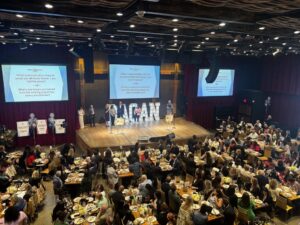
This week, communicators from across industries gathered in Boston to tackle some of the biggest challenges facing employee comms today. Discussions ranged from how comms can shepherd employees through AI adoption to manager enablement and culture building.
Here are some of the biggest takeaways from the conference’s speakers.
Caroline Gransee, senior director of strategy and internal communications, Covista
AI can be scary for employees, but when communicators approach AI adoption as a cultural moment, it can help normalize the change.
Mari Considine, chief brand and marketing officer at Acenda Integrated Health
You might say that you’re not a numbers person. But you don’t need to become an accountant. You need to translate what the numbers mean for leadership.
Marta Ravin, founder, Marta Ravin Productions
AI can distribute information, but it can’t foster a sense of belonging. It doesn’t know how to recognize someone for a job well done. It can’t look your boss in the eye and say, ‘Don’t worry, I’ve got this.’ That’s the type of engagement that creates a positive company culture.
Read more from Ravin’s keynote.
Allie Wickert, director of internal communications, Yahoo!
AI will never sit across from a nervous executive and tell them what they need to hear before an all-hands. It won’t build trust with a skeptical workforce or know when the right answer is to say nothing — that’s still the communicator
Amira Barger, executive vice president, D & A Communications
We spend so much time refining the message, but the audience isn’t judging the structure. They’re filtering everything through their own lens of experience, context and trust.
Russell Evans, head of commercial banking communications at M&T Bank
AI;DR is the new TL;DR. If employees suspect a message was written with AI, they won’t trust it. If the internal communicator doesn’t have the time or energy or care to write a message, why should the employee take the time, energy and care to read it?
Katie Satterlee, internal and editorial communications specialist at Roku
When you work in internal comms, your colleagues are your customers.
Dr. Zac Kostusyk, lead for leadership development coaching quality & employee enablement at Wayfair
Focus is fertilizer. People focus on what grows. Communicators can’t send one message and then stop. They need to keep employees focused on what they want to change or address. Engage again and again.
JJ Nelson, director of brand communications, Bergmeyer
Abstract values only become real to your employees when you activate the values by giving your staff dedicated time to experience them.
Jessica Pantages, vice president of corporate marketing, Egnyte
Internal memos are one-way communication. And they’re important, especially in times of change, but we also need to be connected. We need to forge a strong narrative for employees when things shift and that takes a holistic approach.
Brooks Newkirk, director of executive and internal communications, Honeywell
If a manager can’t instantly see where a comms toolkit fits into their day, it’s not a toolkit. It’s homework.
Julia Minson, professor of public policy, Harvard Kennedy School of Government
Disagreement is not the same thing as conflict. When people consider others with different perspectives, we can better forecast what lies ahead for our organizations.
Sean Devlin is an editor at Ragan Communications.




Excellent summaries. As we said in J-school, Sean followed the ABCs: accurate, brief, clear