‘You don’t need to be an influencer to think like a creator’
Live coverage from Ragan’s Future of Communications Conference.


Communicators are already creators, whether they recognize it or not.
While perhaps they don’t have the breezy, “what’s up chat, smash that like button!” persona many influencers are known for, the key skills and competencies one needs to reach modern audiences are the same that influencers have mastered over the last decade.
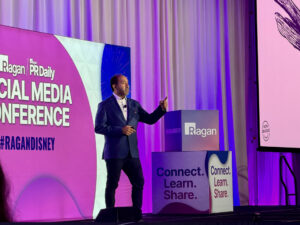
“You don’t need to be an influencer to think like a creator,” declared Shira Lazar during the opening keynote of Ragan’s Future of Communications Conference. Lazar knows plenty about being a creator: She’s a TIME100 Creator and founded digital news brand What’s Trending, which boasts more than 3 million followers.
“Thinking like a creator is a mindset,” Lazar said. “It’s not just a job title. It’s not just about creating content. It’s about sharing our expertise, building trust, connecting with people and navigating change.”
Lazar outlined five questions communicators should take back to their teams to outline their creator mindset shit.
What do we uniquely know?
The creators and brands who thrive the most don’t try to be all things to all people. They lean into the content only they can create.
“We are going from the attention economy to the credibility and practical value economy,” Lazar said. Audiences want content that makes them pause and say, “I hadn’t thought about it that way.”
Lazar provided the example of the Louisiana Crawfish Company, a more than 40-year-old business that’s going viral by sharing what they know best: crawfish.
A simple video explaining how crawfish are harvested and how the pond is maintained can yield more than 2 million views.
“They’re not building formats,” Lazar said. “They’re literally documenting what they know best.”
Whose voice has credibility?
Sticking with the Louisiana Crawfish Company for a moment, their content also works because it’s conducted in the field, with a real crawfish farmer and his son. It feels real.
“We want to see people, humans, stories. Who’s the person behind that company?” Lazar said. And that doesn’t always mean a company leader. This can be a bottom-up approach that highlights the contributions of rank-and-file workers who know the daily work of the business and can explain it in plain language.
How are we showing up for our community?
Content that is purely transactional will fail.
“A lot of times, as comms people, external, internal, you’re only showing up when you need something, and I get it. But that’s not how you build a human relationship,” Lazar said.
The most successful creators check in frequently, even when there’s nothing that can immediately be gained. Commenting on other creators’ content, reaching out to employees even when there’s nothing new and generally staying in touch is powerful.
“Fifty percent of the work is the post, and 50% of the work is what comes after the post,” she said.
Are we giving more than we ask?
Similarly, Lazar warned that communicators shouldn’t just “extract” from audiences. Content needs to be additive and truly improve people’s lives.
“Don’t just tell people the information that’s already out there,” she said. “How are you adding value to that subject?”
You need to provide so much value to content consumers that when you do make an occasional ask of their time and money, people are willing to return the favor.
What can we test in the next 30 days?
Most importantly? Just get started. You don’t need to feel like you need to have a whole plan sketched out from the start.
“Test things quickly. Fail fast. Double down on what’s working. Let go of what’s not,” Lazar advised.
Lazar’s suggested first step is a small one: Write down the one question people always ask you or your organization, then answer it in a post, a short video or a team discussion this week.
Her broader advice for getting there was simple.
“Lean into you, lean into what makes you human, lean into your humanity,” Lazar said. “We’ve each been through such unique things in our lives. That is what is going to make you stand out.”
Allison Carter is editorial director of PR Daily and Ragan.com. Follow her on LinkedIn.