Six internal comms trends every communicator should know in 2026
Explore the surprising forces — from smarter tools to trusted voices — that are transforming how organizations communicate with their people in 2026.

If you’ve been working on your internal comms strategy, you’ve probably already felt it — internal communicators are stretching in every direction.
The expectations are higher, timelines are tighter and somehow inboxes are still getting fuller. And according to our Internal Comms Trends Report (our biggest dataset yet!), 2026 is the year that is defined by smarter systems, clearer channels, and yes, a whole lot of AI and automation!
Here are six trends shaping internal comms in 2026!
Managers are still the biggest priority (and the biggest gap)
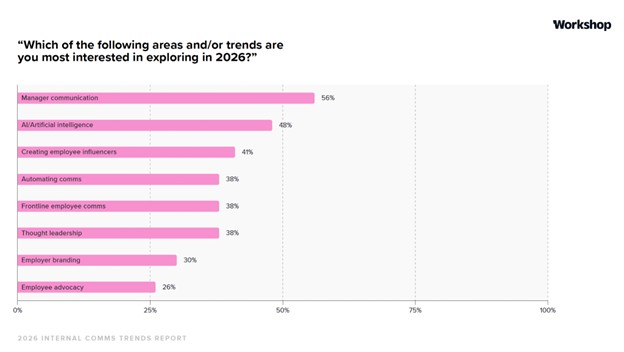
More than half of communicators (56%) say manager communication is their top focus for 2026. At the same time, only 4% believe managers are very effective at cascading messages.
Why does this matter? Employees trust their managers more than any other source. When leaders miss context, skip steps or soften key messages, the entire cascade wobbles.
In response, teams are building more structure around manager communication. Toolkits, leader digests and clearer cascade expectations are becoming standard, not optional.
If there’s one takeaway here, it’s this: supporting managers isn’t a nice-to-have. It’s one of the most important ways to improve how communication actually lands.
AI has moved from experiment to everyday
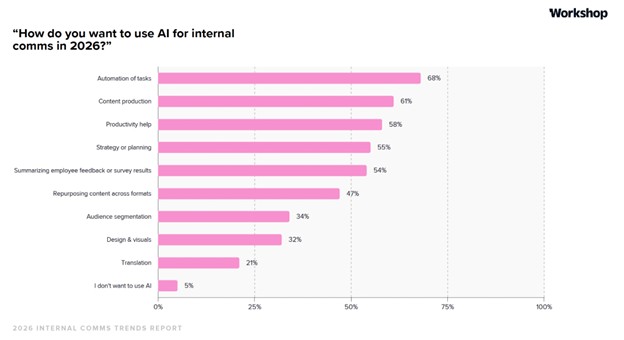
AI has quickly become part of the daily workflow for many communicators. 42% use it every day, and another 31% use it several times a week.
Content creation is still the most common use, but that’s only part of the story. Teams are also using AI to summarize employee feedback, support planning and adapt content across channels.
What stands out is not just how often AI is used, but how it’s being used. It’s not replacing communicators. It’s helping them move faster on repetitive work so they can spend more time on clarity, tone and strategy.
That shift is where the real value shows up.
Email isn’t going anywhere
In this year’s report, 81% of communicators named email their most effective channel, far ahead of in-person events (35%) and intranets (31%). It’s still the anchor of internal comms.
And it makes sense why! Email reaches everyone (not just desk workers) and provides clear data on what’s working.
Also, email is predictable. Employees know where to look, when to look, and what they’ll find. And that consistency builds trust, which makes your other channels work even better.
In 2026, teams aren’t picking one “best” channel. They’re pairing strong push channels (like email and SMS) with intentional pull channels (like intranets or hubs) to create a system that meets employees where they are and supports them when they need to find something later.
’Do more with less‘ is finally getting some pushback
Only 44% of communicators say they have the resources they need to execute their 2026 strategy. That leaves more than half doing critical work without enough time or support.
Instead of trying to absorb that pressure, many teams are becoming more deliberate about how they work. They’re introducing intake forms, setting clearer timelines and building templates they can reuse.
Just as importantly, they’re getting more comfortable saying no or pushing work to a later time.
This is a sign of a maturing function. Protecting your team’s time is not a blocker to good work. It’s what makes consistent, high-quality communication possible.
Intranets are hard, but teams aren’t giving up
The intranet continues to be one of the most challenging channels. 29% percent of communicators say it’s the hardest channel to manage, yet more than half are prioritizing improvements this year.
What’s changing is how teams define success. Instead of trying to make the intranet do everything, they’re focusing on what it does best. That usually means serving as a reliable home for evergreen information like policies, FAQs, and how-to guides.
When the intranet plays that role well, it supports the rest of the channel mix rather than competing with it.
Employee influencers are gaining real traction
One of the most interesting shifts this year is the growing focus on employee influencers. 41% percent of communicators say this is an area they’re actively investing in.
These aren’t formal ambassadors or highly polished spokespeople. They’re the people inside your organization who others already trust and listen to. They shape how messages are interpreted, shared and remembered.
When internal comms teams learn to identify and support those voices, communication starts to feel more natural and more credible.
If you’re looking for a place to start, pay attention to where engagement is already happening. Look for the people whose messages get responses, whose posts spark conversation or who others turn to for clarity. Influence is usually easier to spot than it is to create from scratch.
We’re continuing this conversation at the Ragan Employee Comms and Culture Conference
If you’re attending Ragan’s Employee Communications & Culture Conference in Boston this year, we’d love to build on these ideas together.
Workshop’s Jamie Bell will be leading a session called A Fun & Cringe-Free Guide to Creating Employee Influencers. It’s focused on practical ways to identify and support trusted voices inside your organization without creating a heavy program or adding extra work.
If employee influencers have felt hard to define or even harder to act on, this session is designed to make the concept feel approachable and useful.
Grab your copy of the full 2026 trends report, and we hope to see you at the session.