The rise of the data-driven internal communicator
Storytelling got you in the door. Data literacy earns you a seat at the leadership table.

Many internal communicators entered the profession because they loved writing. They were storytellers, journalists, culture builders and trusted partners who knew how to make complex information feel clear and relevant.
Those skills still matter. But they are no longer the full job description.
Today, communicators are expected to do more than create and distribute content. Leaders want to know whether employees received a message, understood it, acted on it and connected it to the organization’s priorities. They want evidence that communication is helping the business move forward.
That expectation is reshaping the profession.
The most effective internal communicators increasingly combine creativity with data. They analyze employee behavior, identify communication trends, test different approaches and turn their findings into recommendations for leadership.
In many ways, internal communications is becoming a data profession.
Why great writing is no longer enough
For years, internal communication success was often measured by output. How many newsletters went out? Was the CEO announcement published on time? Did the campaign launch across every channel?
Those questions are still relevant, but they focus on what the communications team produced, not what the communication accomplished.
Today, the more important questions are:
- Did employees pay attention?
- Did they understand what was expected of them?
- Which groups did the message fail to reach?
- Did the communication change behavior?
- What should we do differently next time?
This shift reflects a broader change in how organizations evaluate their functions. Communications teams, like their colleagues in marketing, HR and operations, are increasingly expected to show how their work supports business priorities.
The workplace has also become more difficult to read. Hybrid and distributed work have removed many informal signals communicators once relied on. Employees receive information through email, meetings, intranets, chat platforms, mobile apps and other channels, often while managing competing demands for their attention.
AI is accelerating the shift. When content can be drafted and repurposed faster, creating more of it is not necessarily the highest-value contribution a communicator can make. Strategy, judgment and interpretation become more important.
The question is no longer simply, “Can we create this message?”
It is, “Should we create it, who needs it, how should we deliver it and what evidence will tell us if it worked?”
From content producer to communication strategist
The traditional responsibilities of internal communicators are not disappearing. On the contrary, they are expanding.
A communicator may still write newsletters, but now they are also expected to optimize their performance. They still send announcements, but they must understand how different audiences engage with them. They may report open rates, but they also need to identify patterns and explain what those patterns mean.
The evolution looks something like this:
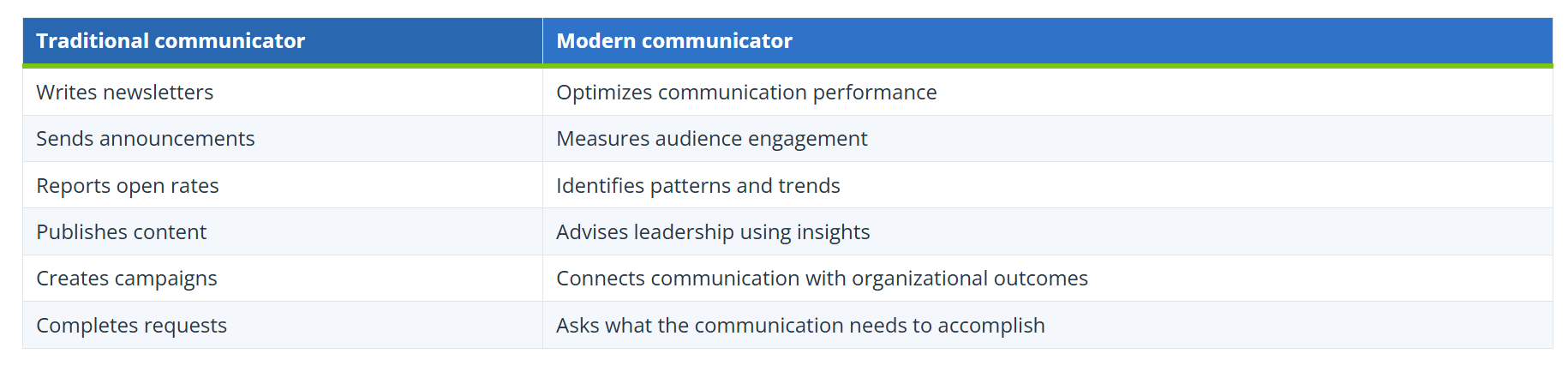
Modern internal communication is no longer a one-way process that ends when a message is published, but rather a continuous cycle of planning, delivering, measuring, and improving.
That changes the communicator’s role. The communicator is still a writer and storyteller, but is also becoming a strategist and interpreter of employee signals.
What data-literate communicators do differently
Data literacy does not require becoming a data scientist. Communicators do not need to master advanced statistical models or spend their days inside spreadsheets.
They do need to ask better questions.
Rather than viewing each campaign in isolation, a data-literate communicator looks for patterns:
- Which messages consistently hold employee attention?
- Which audiences are being underserved?
- How does message length affect reading behavior?
- Which channels work best for different types of information?
- Does engagement change depending on the sender?
- Where are employees signaling confusion or fatigue?
- Which communication approaches should be repeated, adjusted or retired?
An open rate may indicate initial activity, but it cannot independently tell you whether employees understood a message, found it relevant or completed the requested action. Communicators need to consider multiple signals, including reading behavior, link activity, employee feedback, survey responses, sentiment and relevant business outcomes.
They also need to understand the limits of those signals. A metric is not a conclusion. It is one piece of evidence that must be interpreted within the context of the organization, audience and communication objective.
The expanding communicator skillset
Writing, editing and relationship-building remain foundational. But modern communicators also need capabilities that help them make more informed decisions and communicate their value more clearly.
Interpret analytics and identify patterns
Communicators should understand what different metrics measure, how they relate to communication goals and what they cannot reveal. A click or open may indicate activity, but additional context is often needed to determine whether the communication achieved its purpose.
The greater strategic value often emerges over time. By looking across campaigns, audiences and channels, communicators can identify recurring behaviors, information gaps and meaningful changes that might otherwise go unnoticed.
Understand audiences and test assumptions
Employees are not one uniform audience. Frontline workers, office-based employees, managers, new hires and employees in different locations may have distinct needs, habits and access to information.
Segmentation helps communicators determine whether a message, channel, format, sender or schedule should change for a particular group. Testing those decisions against employee behavior can reduce guesswork and reveal opportunities for improvement.
Put performance into context
A number without context can be misleading. Benchmarking helps communicators compare results with previous campaigns, organizational averages, relevant employee groups or appropriate external reference points.
The goal is not to pursue a universal definition of “good.” It is to understand what typical performance looks like for a particular organization or audience and recognize when something meaningfully changes.
Turn findings into business guidance
Leaders rarely need every available communication metric. They need to understand what happened, why it matters and what should happen next.
Strong executive reporting prioritizes insights over activity. It connects communication performance with organizational priorities and gives leaders clear information they can use to make decisions.
Data makes storytelling more strategic
The growing emphasis on analytics can prompt understandable concerns. If communicators become preoccupied with dashboards, will creativity and human connection suffer?
They should not.
Data and storytelling perform different but complementary functions. Data helps communicators understand employee needs and behavior. Storytelling gives information meaning, context and emotional relevance. Measurement helps determine whether the story had its intended effect.
Research reinforces the broader relationship between communication and engagement. A survey of 3,457 employees found that satisfaction with internal communication positively influenced employee engagement. A systematic review published in 2025 examined 55 studies and identified internal communication, employee engagement and job satisfaction as central themes in the research.
None of this means data should dictate every creative decision.
If previous results show stronger readership for manager-sent messages, that does not mean every message should come from a manager. It gives the communicator a signal to consider alongside the purpose, audience, and organizational context.
Professional judgment still matters. So do empathy, ethics and an understanding of the employee experience.
Data does not replace those qualities. It gives communicators another way to apply them intentionally.
Stop reporting metrics. Start explaining what they mean.
The strategic value of measurement lies in interpretation.
Consider the difference between a metric, an insight and a recommendation.
Metric: The newsletter had a 72% open rate.
Insight: Employees opened the newsletter, but readership declined before the primary call to action.
Recommendation: Move the required action higher in the message and shorten the introductory content in the next issue.
The metric describes what happened. The insight explains what the result may indicate. The recommendation identifies what to do with that information.
The same approach can be applied across internal communication.
If frontline employees consistently spend less time with long emails, sending more reminders may not solve the problem. They may need shorter content, a different format or a channel that better reflects how they access information during the workday.
If manager communications generate stronger readership than corporate announcements, communicators can consider when a direct leadership message would be more effective.
If employees ask the same questions after an announcement, the issue may not be reach. It may be clarity, relevance, timing or missing information.
These findings do not offer universal rules. They create better questions, and better questions lead to more informed decisions.
Data changes the communicator’s seat at the table
Communicators strengthen their influence when they move beyond reporting activity and begin advising the organization.
Instead of saying, “We sent five newsletters,” they can explain which messages held employees’ attention, where engagement declined and how the next communication should change.
Instead of waiting for a leader to request a particular channel, they can recommend an approach based on audience needs, communication goals and past performance.
Instead of presenting a dashboard filled with disconnected numbers, they can focus leadership’s attention on the few findings that require a decision.
This is how communicators become trusted business advisors.
The most influential communicators explain what those results mean, acknowledge what the available data cannot prove and recommend a responsible course of action.
The future belongs to communicators who can do both
Internal communication will always require creativity, empathy and human judgment. Data cannot make employees care, create trust or turn a corporate update into a meaningful story.
But creativity alone is no longer enough.
Organizations need communicators who can understand employee needs, create compelling messages, interpret meaningful evidence and turn what they learn into action.
The future of internal communication is not a choice between art and science. It belongs to professionals who can bring the two together.
Those communicators will not simply produce better content. They will make better decisions, give leaders better advice and help their organizations communicate with greater purpose.
COMMENTS
Join the conversation
Ragan.com Daily Headlines
RECOMMENDED READING





Tags: data-driven