‘There’s no such thing as internal communications now’: The external blur
Reporting from Ragan’s Internal Communications Conference.

Long before a job candidate meets a recruiter, they can read what an organization’s own people think of it. Employees and applicants post reviews of everything from the hiring process to the day-to-day on employer review sites.
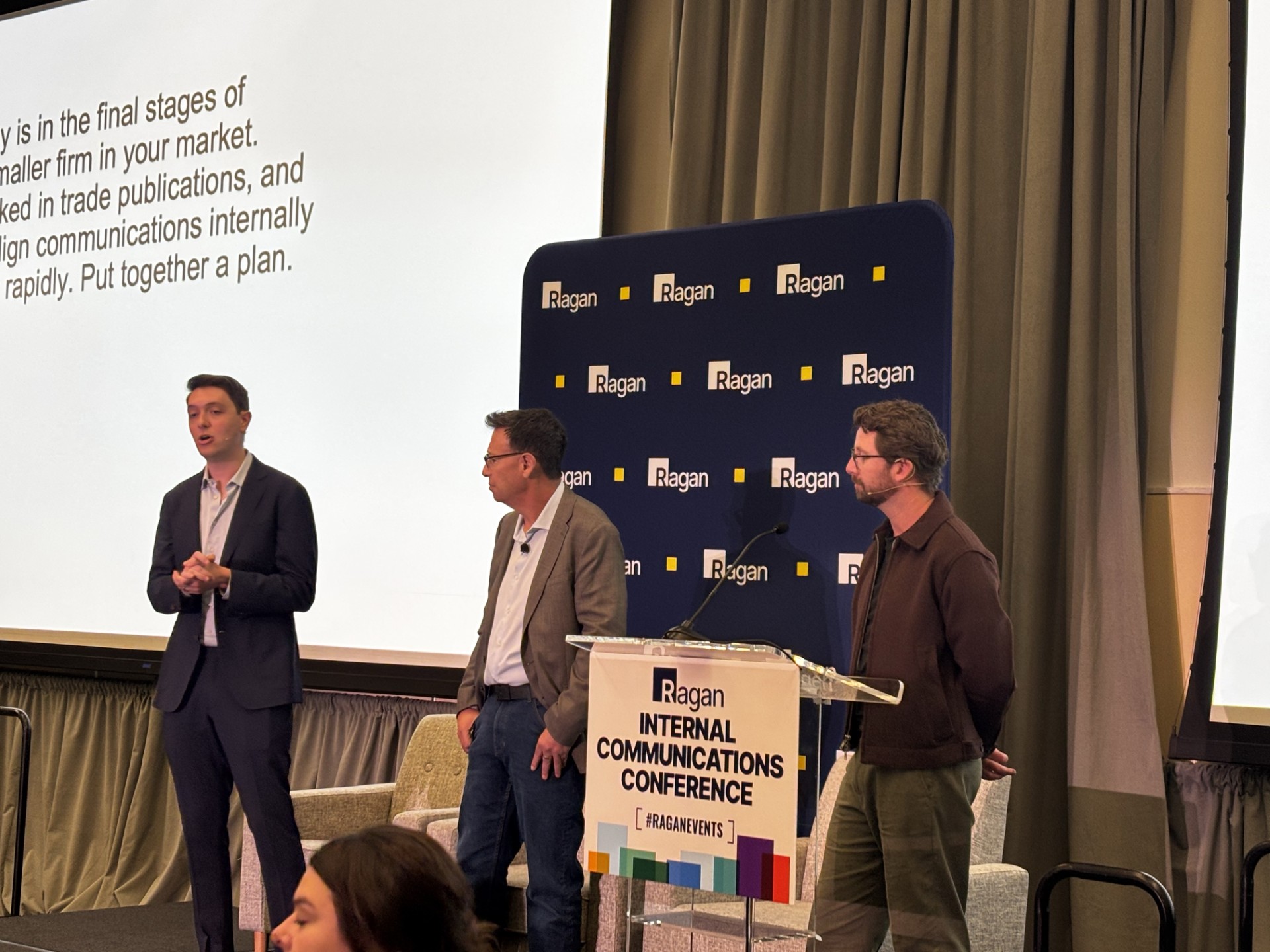
During the preconference workshops at Ragan’s Internal Communications Conference at Microsoft HQ in Redmond, Washington, earlier this week, David Gardner, director of employee storytelling and content strategy at The New York Times, said internal comms pros can’t lose sight of that audience, even while their main focus stays on current employees.
“Our internal story does drive our external reputation,” Gardner told the audience. “Our colleagues can be our biggest cheerleaders or critics. They can support our message or they can detract from it.”
Gardner co-led the session with Scott Pansky, founder of Sandbox Lessons and co-founder of Allison Worldwide, and Matt Prince, fractional head of communications at Sweetgreen. Prince said the line between internal and external communications has started to fade.
“There’s no such thing as internal communications now,” Prince said. “Everything we do internally, we have to assume is going to be external, because many times it is. There’s a blur with executive comms now having a social presence and a blur between paid and earned.”
Go back to the sandbox
Years ago, when Pansky asked former employees what had gone wrong during their time at his agency, one answer stood out.
“They started saying, ‘I’m afraid to have lunch,’” Pansky said. “Our employees feel like they can’t leave their desks. They have their headphones on. They’re stuck on their computers, and if they leave, they’re going to miss something and let somebody down.”
Pansky treated his agency’s issue as a communications problem as much as a cultural one. His fix was a retreat to redefine the agency’s core values. At a team member’s suggestion, he built it from the junior staff up rather than the senior leaders down. The definitions those 50 junior employees wrote then stayed in place for 15 years.
“We quadrupled the company,” Pansky said. “But it was all about focusing everybody on that cultural north star. It all comes down to giving people direction and clear communication.”
Decide what messages travel
Prince posed a question every internal comms pro is familiar with: When does a message need a press release, and when is an internal memo the way to go?
Prince’s path to the answer is a “carry test” made up of three questions that decide whether a message goes to everyone, stays with an affected audience or doesn’t require communication at all.
- Will people share it? Will it resonate and would employees want to pass it along?
- Will others back it up? Is something actually changing and can you demonstrate how?
- Will it stick? Can you sum it up in one sentence?
“Stories don’t travel because brands publish them,” Prince said. “Stories travel because people carry them.”
Prince grades each answer from 0 to 2. A middling score isn’t an automatic no, but a cue to work with other teams and make the story bigger.
“One of the most powerful tools as a comms team is saying no,” Prince said. “Something that takes the subjectiveness out of it is grading, providing scales for the communications that come in. If a message is only going to score about a five, it’s not going to a place where it needs to be external, and that helps educate executives.”
Earn more ownership
Gardner’s team rebuilt the Times’ intranet, replacing two separate intranets and 50,000 pieces of mostly outdated content with one hub that more than half the company uses weekly. That work earned the team enough trust with executives, technology, HR and legal to take over the company’s external corporate site, a project it wouldn’t normally have been given.
“People are afraid to lead outside of the C-suite and afraid to be the person who owns the project,” Gardner said. “Looking out at all of you, I can see that you’re extremely competent professionals, and you should be the people who are leading the charge. Your colleagues will be grateful.”
Stay tuned to Ragan.com for more updates from our Internal Communications Conference this week.
Sean Devlin is the internal communications editor at Ragan. You can connect with him on LinkedIn here.