What employees actually want their employers to speak up about
Most employees don’t want to hear a company’s stance — with a few notable exceptions.


Most employees aren’t looking for their employers to take stances on social issues, according to new data from Gallup and Bentley University. But there are clear exceptions — and plenty of questions remain.
According to the survey of more than 3,000 Americans, only 44% want their employers to speak out on social issues as a whole. That’s actually a slight increase from 40% in 2025, perhaps showing an increase in thinking about these concepts as a whole during an election year.
But when we drill down into specific topics, employees clearly do want to hear from their employers on a variety of topics. Most clearly, employees think their workplaces should communicate about mental health (62%), healthcare (56%), diversity, equity, and inclusion (56%), and free speech (52%).
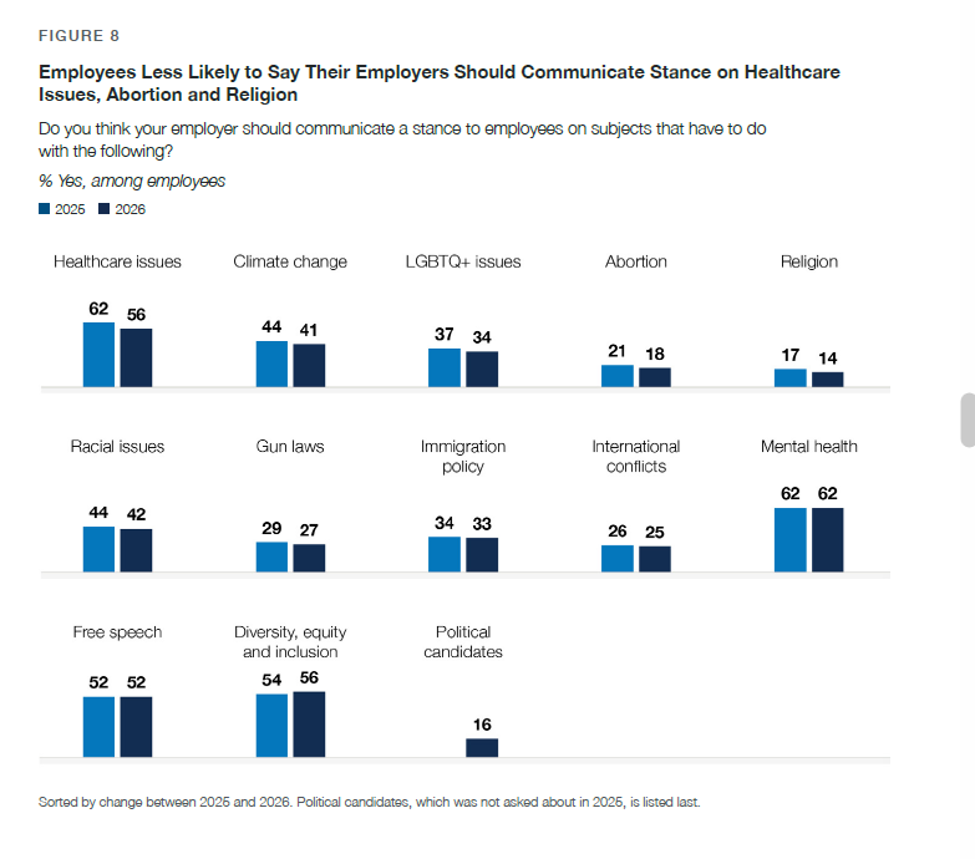
In some of these, we can see the obvious ties: Mental health deeply impacts work and is impacted by work. Healthcare is often provided by employers, so people want to hear what they have to say about the topic.
Diversity, equity and inclusion has become a dangerous term under the Trump administration, opening organizations up to legal exposure, depending on how they’ve implemented the concept in their hiring and promotion. Based on this data, we don’t know what stance people want their employer to convey about DE&I, only that workers want to know what it is. This, combined with the fact that only 41% of employees think companies should speak up about LGBTQ+ issues and 42% think they should speak on racial issues, gives us a nuanced picture.
This also raises questions about what exactly it means to “communicate a stance.”
Is featuring a same-sex couple as part of an intranet article “communicating a stance”? Is discussing a Black employee ERG “communicating a stance”? Some may even see the promotion of a person of color to be a stance toward DE&I. It’s all in the eye of the beholder.
The lines aren’t quite as clear-cut as simply choosing whether to issue a statement or even celebrate an affinity month. In today’s hyper-politicized world, any inclusion or exclusion can be seen as a stance.
Likewise, it’s difficult to know what “free speech” means in this context. Are respondents thinking of instances where employees were terminated for criticizing Charlie Kirk in the wake of his murder? Or perhaps it’s people who work in media concerned about crackdowns from the current administration? Is communicating a stance as simple as sharing a policy around what off-the-clock speech can result in on-the-job sanctions?
The answer is going to look different for every group of workers, all of whom have different demographics, concerns and needs.
Related data from Gallup and Bentley found that external audiences who most wanted to hear social stances from companies tended to be younger, Democrats, people of color and women. We don’t know if these exact demographics hold up for internal audiences, but it’s safe to say there’s likely some overlap.
What this means for internal communicators
The best place to begin is where there is direct overlap with work. Mental health and healthcare top the list because employees see a direct connection to their overall wellbeing. These are areas where communicators can build trust through regular, practical content. This can help build a foundation for other areas where communicators can focus on substance over statements. Employees usually care less about fancy statements than the policies, benefits and practices that shape their daily work.
Make sure you’re communicating stances your audiences actually want to know and not talking just to talk. Use pulse surveys and manager feedback to learn which issues your employees care about and how expectations differ.
Most employees simply want honesty about the issues that affect their work and lives. Keep your focus on serving that need above all else.
Allison Carter is editorial director of PR Daily and Ragan.com. Follow her on LinkedIn.